Working Document: CPATH II Planning
Posted On Wednesday, December 23, 2009 at at 12/23/2009 09:22:00 AM by L Santoro
Please see this link for the Strategic Planning Document as of 12.18.09. It is a work in progress and the next work session is 1/22/10 in FL1-8 from 8am to 12noon.
http://docs.google.com/Doc?docid=0Aei2hdsuTyDTZG01azVjbV83ODVnaGpnbXdoYg&hl=en
On Education Inspiration and CT Innovation
Posted On Friday, December 11, 2009 at at 12/11/2009 08:02:00 PM by Ray DePena
Geoffrey Canada on 60 Minutes: Closing The Achievement Gap through the Harlem Children's Zone.
Having seen the success of the Harlem Children's Zone, in 2009 US President Barack Obama announced plans to replicate the HCZ model in 20 other cities across the nation.
You can view a brief clip below or the full episode by 60 Minutes. 
At least 180 million children could use glasses to help with their schoolwork, according to a report from the Child Vision Conference in Oxford in 2007.
Prosperity Index
Posted On Monday, December 7, 2009 at at 12/07/2009 09:55:00 AM by Gary Hartley
In the December 4 ExecCom meeting, there was a brief discussion about how business, industry and government assess the growth and economic health of the Sacramento region. In a partial answer to this question, I would offer the 2009 Prosperity Index published by the Center for Economic Research. The PDF version of the report linked above is quite interesting, and I think give us a good grounding in how these assessments are made and presented. Take a look!
Computational Thinking from a Healthcare Perspective: By Jim Eldridge from the CPATH AdCom group
Posted On Monday, November 30, 2009 at at 11/30/2009 01:19:00 PM by Gary HartleyAs I sought out inspiring examples of computational thinking, I looked up quite a few articles on computational thinking and watched Dr. Wing’s YahooLabs presentation on the subject. Most were interesting, but still left me without a crystal clear idea of what CT is or what “inspiring examples” of it would be. Rather than be paralyzed in thought or analysis, I decided to just start jotting down my notes and thoughts and see where that takes me. I also decided to focus on HealthCare since that is my identified area of contribution to the group. So here goes:
Dr. Wing’s article identified examples of computational thinking such as robotic surgery, virtual colonoscopies, and electronic health records. I will comment on these and others I think appropriate, but before doing so I would add that I think the opportunities for using CT in healthcare are tremendous for the following reasons:
It is extremely complex. Ethical issues abound in healthcare, and the number of dollars spent at end of life can be staggering for what, in many cases, are inevitable outcomes. Technology has played a huge role in improvement of outcomes but at a huge price tag. Chronic conditions and risk management issues are enormous. I will never forget a visioning session with my staff regarding how the implementation of the electronic medical record was going to change what we do, and we concluded that though we currently manage masses of complex data, in the future would be managing more masses of more complex data.
There is currently a lot of waste. The estimated impact of poor quality or waste in the healthcare industry is staggering. This comes in many different forms, including errors, unnecessary procedures and care, etc.
We have a problem, Houston. Healthcare costs are creating a real problem for American businesses. It is a problem that definitely needs to be solved.
Okay, here are some overall comments on things that I have witnessed relative to computational thinking in healthcare.
1. We have been doing it for a long time. Over 20 years ago we were looking at how we could use computational thinking (I think it could be described as that) to improve patient outcomes. We did this in a lot of ways, but I think one good example (although very simple) was looking at our databases to ensure that diabetics were hooked up with an ophthalmologist. Diabetics have a much higher propensity for eye disease. We did this by looking at prescriptions for insulin and ensuring that anyone who had been prescribed insulin was also seen by an ophthalmologist.
2. Electronic Medical Record. This component is still very early in its implementation, but there have been several findings from it.
· Medication errors were reduced tremendously. The system provides for checks and balances on medications and automatically checks for anything outside of those parameters and requires override to be administered. This has resulted in a big drop in medication errors.
· Some unintended consequences. Redacting medical record data became much more difficult, requiring a lot of work to set up parameters for what really is the record, what should be printed out to share for a variety of sources, i.e. claim and attorney review.
· Not tremendous cost savings—yet. Perhaps that is the great test of how to utilize the data in a manner that will result in savings.
3. Google is better at predicting the flu season than the CDC (Center for Disease Control). Some comments on this are shared below, but I agree that this really opens up the idea at looking at healthcare data and outcomes in a totally different light, and probably indicates a need for expertise outside of the traditional healthcare arena. Google’s experiment in trending flu outbreaks is absolutely – and I mean absolutely – amazing. I’d bet that any professional epidemiologist would cringe at the idea of using non-clinical data to identify disease trends, but this application boggles my mind. Here’s how it works. Google meters its search queries on flu-related topics, figuring that the more that people search on a flu topic, the more likely the flu is occurring in real life. It does not measure anything clinical – nothing about positive throat cultures, visits to emergency departments, or any other traditional sentinel reporting measures. Just search queries. The demo on Google’s own website shows how, using data from the 2007-2008 flu season, it can identify flu trends two weeks ahead of anyone else, including the CDC. The data for this current season – the first full season with the H1N1 virus – confirm that many people are getting sick with the flu already, months before the traditional height of the flu season.
4. Robotic Surgery—da Vinci machines are an example of advances in Robotic surgery and I believe were invented with the intent of enabling the ability for someone across the globe to complete and do a surgery on someone on the other end. It also circumvents current limitations in the design of the human body. For example, the human wrist cannot perform a 360 degree rotation, while the robot can. This allows for a better range of performance and thus, better outcomes. Cost becomes another large issue here as it is very expensive. But the da Vinci robots eliminate two big issues in surgical care:
· Physical location of the surgeon—the surgeon could be across the globe and complete the surgery with the appropriate equipment.
· Physical limitations of the surgeon—i.e., the 360 degree rotation of the wrist.
And from the neither here nor there category, I always find quotes inspiring. I liked the following and found it while I was searching. It does not apply directly to computational thinking, but you get the idea:
“Digital fluency" should mean designing, creating, and remixing, not just browsing, chatting, and interacting.
Mitchel Resnick
Innovation and Technological Convergence With Our Physical World
Posted On Sunday, November 22, 2009 at at 11/22/2009 06:25:00 PM by Ray DePenaI searched high and low for an innovative approach that met the CT requirements of Dr. Peckham's, "...absent the computer...", and Jeannette Wing's, "...way humans, not computers, think, solve problems..." providing a point of reference for our students to become inspired and intrigued in the potential promise of technology, and came across this piece. Enjoy!
CPATH II Proposed Timeline
Posted On Thursday, November 19, 2009 at at 11/19/2009 04:29:00 PM by Gary Hartley
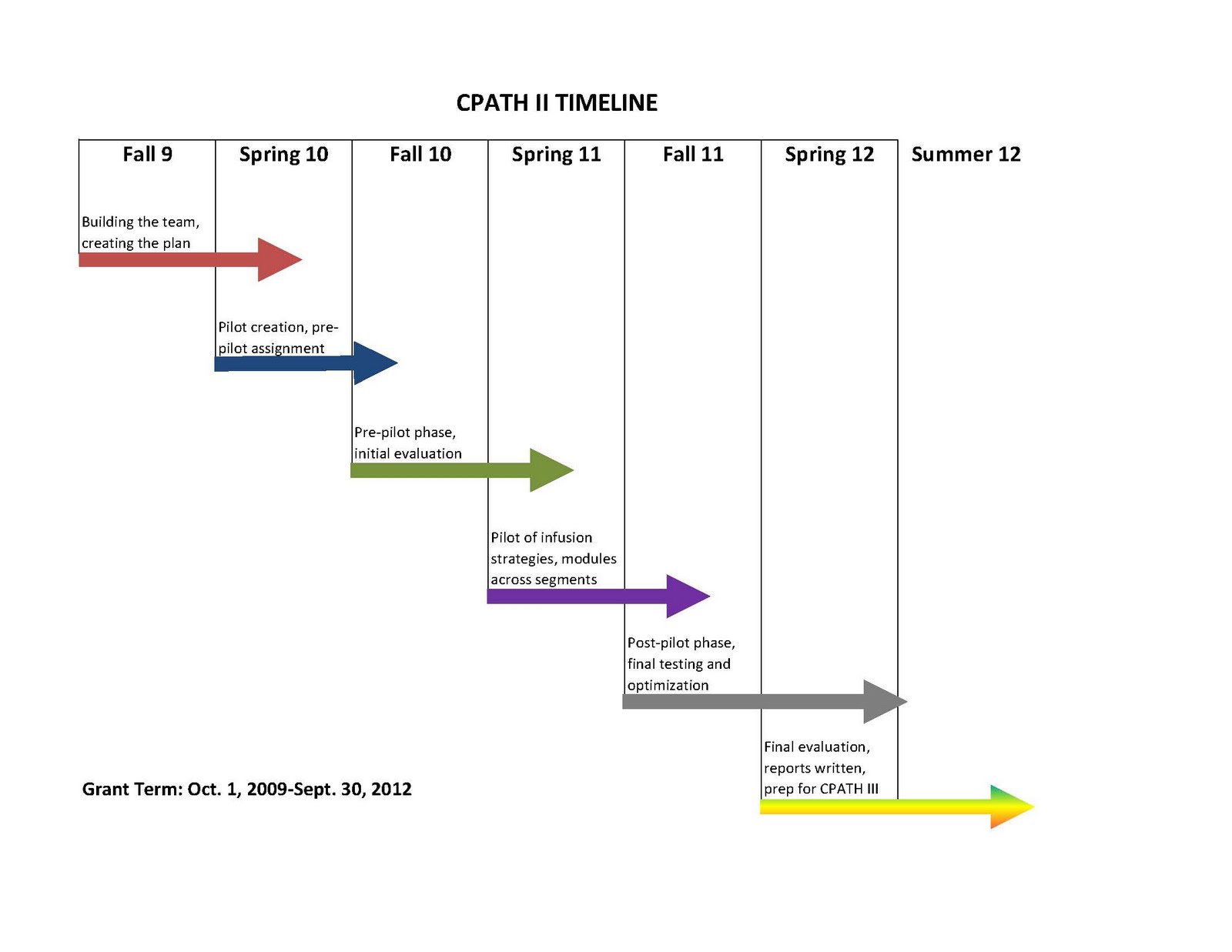
In preparation for the many months of meaningful work ahead, the Executive Committee has prepared the following proposed (and certainly changeable) timeline for the term of the grant. This will be discussed in detail in subsequent meetings.
In addition to the above calendar, the executive committee is now working with a new proposed group structure. It can be "briefed" as follows:
- The executive committee (ExecCom for short)is a group of approximately 12 core individuals charged with overall planning, implementation, mentoring and guiding throughout the term of the project. They lead the larger group, establish time lines, and have clearly defined responsibilities (e.g., facilitation, work product development, BLOG management)
- The task group (TaskCom for short) is made up of additional individuals charged with spearheading development of CT modules and infusion strategies for all segments and disciplines in education. Smaller task groups will be derived from this group with the addition of others, and each will presumably accomplish its task with a slightly different approach.
- The advisory committee (AdCom for short) is the largest group, and includes potential members from a variety of groups and individuals with an interest in the project. They will provide input to the other groups on the progress of the project through a variety of communication channels. All members of this group will be charged with bringing others to the table, and with spreading the word to colleagues and contacts in the community. This will be the most fluid group, and the one withe the least-defined responsibilities. It will also meet with the least frequency.
Soon, ExeCom will act on codifying this proposed group structure, and will set out schedule for future meetings for each of the three groups.
On CT Framework and Rebranding CISE
Posted On Sunday, November 8, 2009 at at 11/08/2009 04:33:00 PM by Ray DePenaThe recent e.mail exchange regarding the unmentionable, "E" and other "scary" CISE terms brought to mind the discussion regarding re-branding of these terms. So I've put together a few thoughts along those lines. The key question being,
"How can we get the student's attention, and interest in CT / CISE subject matter?"
FLC could provide for a cross-disciplinary Managed Information CT Education Framework with coursework that is sufficiently broad based, innovative, and flexible enough (as technology and industry evolves) to act as a clearinghouse between student's career objectives / aspirations / desires and the skilled labor requirements of business in the year 2020, while maintaining overall education goals for a variety of student segments..
We could begin with:
I. An Introduction to (Computational) Thinking - a G.E. prerequisite that is broad based, illustrating problem solving, information management, introduction to industry (and government), future career options and skills required by employers, student interest, and skills development.
The CT General Education (G.E.) Disciplinary framework could provide for:
- Personalization & Participation: Offer program tracks that engages their interests (CT tracks).
- Speak in their language and the language of industry/business (re branding taxonomy from traditional to modern)
- Provide a pathway to jobs and career opportunities.
- Show students the opportunities to achieve their aspirational goals via their interests.
- "Soft" start through functional disciplines of interest to them and re branding of CS terms (more on that below).
- Targeted student segmentation - student focus, attention via broad based CT introductory prerequisites. and career exploration embedded in the course.
- Speak to their altruism - Innovation -"Change the world" opportunities - technology in alternative energies, health care, media, entertainment, entrepreneurship, industry, government, education, etc.
III. A G.E. Innovation in Information Management Pathways Program (for Services and Industry) that delineates disciplinary functional tracks with some core courses and elective (experimental) disciplinary industry offerings.
Ex: Innovation in Health care; Innovation in (place industry here)
Ex: Innovation in Marketing; Innovation in (place business function here)
The program prepares its students to learn to think critically (CT) in the identification and analysis of complex systems and work with/manipulate abstract conceptual frameworks to derive, create and deliver value for the organization (beyond the G.E. beginning CT course) within the context of a discipline of their interest.
IV. Beyond the Introduction to CT (G.E.) coursework, and its application to a particular discipline, we then engage the students in the possibilities of such thinking by enabling the study of CT in Innovation as an interdisciplinary subject.
Introduction to Innovation in [insert discipline here]; or "Introduction to Next Generation Disciplines"; a hook, to bring in the audience and have them learn to apply CT in an interdisciplinary manner while simultaneously exploring the potential possibilities of many career paths as they work with students from different tracks in the program.
V. Re-branding (and re-engineering) of existing coursework to express the CT objectives within core CISE to facilitate access, integration with the CT program framework, and approachability of computer science and engineering subjects.
- Programming? "Introduction to Application Development (Software Engineering) and Management"- inclusion of Facebook development for example, may be more compelling than just traditional languages.
- Database? "Introduction to Information Management"
"Introduction to Business or Office Productivity Suites" where assignments can include presenting a marketing campaign (or other industry specific function/discipline), developing and populating database to feed spreadsheets with pivot tables for calculations merging the results with targeted marketing campaign documents that are published on the web (marketing just being an example of a higher value functional area of potential interest for students).
What thoughts do all of you have regarding the development of a multi-level framework - CT basics, CT + discipline, and CT + interdisciplinary, and the re-branding of terms that perhaps alienate the students from pursuits of such CISE disciplines?